Showing posts with label Redpoll. Show all posts

Friday, 2 November 2012

phylloscopic frustrations!

is 'Phylloscopic' a word? if not then it should be! By the way, this is a write-up of yesterday (1st November), so apologies for it being a bit late!

I started with low expectations, but I did hope the strong South-westerlies that had now been blowing for two days might have brought a Sabine's Gull or a Shearwater into the channel. as it turns out, in 40 minutes my totals were;

ARCTIC SKUA- 1E
Black-headed Gull- about 20W

and that was literally everything! Not even a Common Scoter, a Gannet or a Brent Goose! It's a good thing skua's are such a decent bird, and november is such a good month for them! otherwise I would have considered this rather a wasted 40 minutes.

Another good bird seen was a SCANDINAVIAN HERRING GULL that did a flyby of the groyne at Splash Point. (I know I should have been in the shelters on such a miserable day, but it had been so crap I actually moved onto the groyne thinking I was somehow missing everything from where I had been!) The gull perched down on the concrete path briefly, allowing a fairly good study through the scope, before flying off towards a roost on the beach to the east. I noted


  • a darker mantle shade than  typical argenteus. However, I think this was quite a pale Argentatus, as it was very flat light and the mantle was lighter than some definite scandi's I have seen in bright sunlight! It was quite blueish grey as well
  • increased white on the primaries with big white tip to p10, and a tip-black spot-mirror pattern on p9 (see bad drawing below). 
  • in flight, the deeper breast gave it a more front-forward appearance than a british herring gull (and I checked by looking extensively at the rooftop gulls on the way home to compare!)
  • the head was fully moulted into winter plumage, unlike most of the argenteus that are currently about halfway through (Argentatus on average moults slightly earlier)
  • it had a heavy bill and big, brutish expression, more so than Argenteus. 

In my ultimate show of professionalism, I used Paint to show the primary pattern of an Argentatus! As a btief and interesting anecdote, I actually did a paint drawing to help get a Glossy Ibis accepted a few years back! I will have to dig that out one day!

On my way home, besides some gull-grilling on the rooftops, I also saw a Redpoll on Southdown Road, Seaford, and 4 Siskin flew north over the house. Both decent November records! Dad then told me about a Firecrest he'd seen in Blatchington Churchyard, which I decided to check out. A fateful decision! 

the Firecrest was calling almost immediately, and there were several Goldcrest, Redwing, Song Thrush and Blackbird in the churchyard. I heard a crest flock move off, so I followed them, and positioned myself so they would all be moving right in front of me to go from one tree to the next...

The first bird that dropped into view, I put bins on and thought, "bloody hell!"- it had a supercilium and a strong double wingbar! the super was too dull for Pallas's, so was it a Hume's or a Yellow-brow? It had an overall greyish cast and a very dull supercilium, just like the Hume's Warbler I'd seen in Belle Tout two days previously! But I didn't hear it call, and despite a lot of searching yesterday and today, haven't yet managed to see the bird again! 

However, in looking for it, I managed to see the following around Seaford; 

  • BRAMBLING calling over the Churchyard, the first I'd seen since 7 Oct, and completing the trio of winter finches for the day! 
  • a late HOUSE MARTIN flew over the Churchyard as well, my latest by seven days! 
  • 3-4 Chiffchaffs in Seaford, including one by Seaford Primary School with pluamge looking good for an eastern bird. wouldn't claim it without the call though
  • probably the same Firecrest in a tit flock by Seaford Primary School, giving gorgeous views in someone's garden!
  • one, or possibly two, Mistle Thrushes around Blatchington Hill and Seaford Primary School. 

The mystery warbler was of course frustrating, but it was put into perspective a bit when Jamie and Peter, two great birders from the Brighton area, found a probable YELLOWTHROAT on Scilly, but couldn't quite confirm it! From Peter's description it sounds the genuine article! However Jamie found a Red-eyed Vireo on Scilly last autumn, so it would be rather greedy for those two to claim another yank passerine this autumn!! 


Tuesday, 30 October 2012

shore lark, hume's warbler, young birders field trip!

sorry for the unimaginative title, it's been a long day!

There can't have been many times my patch has played host to four young birders at once.  We're a rare enough breed as it is, to see four together borders on the ridiculous! there have also been few times I've walked as far for birds, and even fewer when I've been so well rewarded!

Perhaps, to begin this post, I'll tell you my predictions, that I'd made the past few days. we would be walking from Seaford to Beachy Head, a decent walk taking in Seaford Head, Cuckmere Haven, the Seven Sisters and Beachy. The winds were NW, and it was set to be a good day weatherwise, with a bit of fog to ground migrants.

I predicted the NW winds would bring some northerly birds down- I was thinking maybe the likes of Lapland Bunting, Snow Bunting, Twite or Shore Lark. It seemed to me the best place to see any of these would be the clifftop of the Seven Sisters- on a similar walk perhaps five years ago I'd missed out on a Shore Lark along here, found on one of the sisters on 1 Oct 2007, and one of the most recent sussex records. Would lightning really strike twice?

My second, more hopeful, prediction was of a phyllosc of some variety. The one at the forefront of my mind was Hume's, though Pallas's and Dusky I also considered good candidates for late October. The winds weren't very good for a new arrival, but maybe a bird had arrived on the east coast, and would be blown down here on it's southward migration?

as it turns out, I think I should consider a career in clairvoyancy! But lets start at the beginning, and move on to the wonderful birds later.

I woke up early, planning to meet up with Jake Gearty, George Kinnard and Luke Dray at 7.30 in Seaford. by 7.23 I was out the door, and almost the first bird I heard was a Siskin in the garden. three Meadow Pipit then flew over, heading due south, and a FIRECREST was in with a small crest/tit flock at Blatchington Pond; there was a lot of activity, and all this before I was really awake!

Having met up with the other three muskateers, we headed towards the seafront. In a very brief seawatch, the first bird Jake saw in his scope was a Red-throated Diver heading west very close in! a few Gannets were offshore, and three Brent Geese passing east were most unbrent-like, going high above the horizon. From Seaford Head, George managed to pick out a female-type Common Scoter, sitting distantly on the sea.

It was around now that the mist started to roll in, and for a while visibility was probably only about 50-100 metres. As we walked up the slope from Splash Point to the Golf Course, the first of several Skylarks were picked up coming in/off, and a MISTLE THRUSH did the same before flying off to the west. This is my first record for Seaford Head, and the species is probably the rarest of the six thrushes on passage in Sussex! This was already and early highlight, and the day was shaping up to be a good one!

On the Golf Course, five Siskin dropped down into the bushes of the northward facing hill, and by the radio mast was a decent concentration of birds, with a few Redwing, Song Thrush, Blackbird and a single Fieldfare, seen by myself and Jake only and the only bird of the day! Non avian highlight of the day was a WEASEL seen here, again a very brief spot by Jake, that I also connected with as it darted across the path. Walking along the clifftop was quiet, though Skylarks and Meadow Pipits were both coming in/off in small numbers.
record shot of the very showy Siskin
(Liam Curson)
Hope Gap was also fairly quiet. We managed a House Martin overhead, perhaps 20 Redwing, 4 Jay, 2 Blackcap, a few Blackbirds and Song Thrushes, 2-3 Goldcrest, and two very showy Siskin feeding in the thistles alongside the path. These were superb views, compared to my typical fly-over views of the species on patch. In fact, I've only really ever had views to match this at feeding stations before! a flock of seven Redpoll also flew overhead, heading down into Hope Gap as we were leaving it. These being my only my second records this autumn, it's not been a great one for Redpolls to my knowledge? After leaving Hope Gap we checked Harry's Bush, which did it's usual trick of failing to live up to all our expectations! 15-20 Goldcrest, 5 Chiffchaff and a Treecreeper were as good as it got! However, George's eagle eyes did notice one Goldcrest had a ring on it's leg, quite a spot on such a small, fast-moving and hard-to-see bird!

My overall estimate for the migrants on Seaford Head today was- 40 Blackbird, 40 Robin, 30 Redwing, 25 Goldcrest, 25 Song Thrush, 25 Meadow Pipit, 20 Skylark, 8 Siskin, 7 Redpoll, 2 Blackcap, 1 House Martin, 1 Fieldfare and 1 MISTLE THRUSH. 

The walk then continued on, to Cuckmere Haven, where there were 250+ Wigeon on the flooded levels, among smaller numbers of Canada Geese and Gulls. In the bushes along the west side were small numbers of Song Thrush, Blackbird and Redwing. a YELLOWHAMMER heard might just be one of the last ones left locally! Last year I counted one singing male in Greenway Bottom and one at Exceat, and these were the only two in an area where you could have, a few years ago, seen 20! It's a sad state of affairs when I'm capital-ing what should be a common bird...


Brent Geese, Cuckmere Haven
(Liam Curson)
two juvenile Brent Geese had found themselves on the River, and were quite literally tame as ducks! Brents are a regular winter visitor/passage migrant in the Cuckmere in small numbers, but this was the first time I'd ever been close enough to hear their grunting calls. There's something quite lonely about hearing them call alone, a sort of parallel to the frenetic energy given off by the sound of a whole flock on an estuary. Meanwhile there were three Dunlin on the meanders, and seven Swallows hawking over the river- will those today be my last of the year? From the riverbank near the sea, the two resident Little Owls could be heard calling from the hawthorn bank the herons and egrets like to roost in- the first time I've heard them in quite a while.

A short seawatch off Cuckmere Haven produced another Red-throated Diver west, and a Common Scoter east- we were going to check the beach for Shore Larks and Snow Buntings but the tide was too high. So we proceded to climb the steep slope of Haven Brow, and see what we could find the rest of the walk to Hope Gap.

The answer resolved itself within about 10 minutes; we first saw a small, dark passerine with a bouncing, skylark-like flight, silhouetted and flying out of sight over the brow of the hill. We joked about this being everything from a Black Redstart to a Black-eared Wheatear, but about three minutes later found ourselves once again looking at the mystery bird- I'd decided it was either a Wheatear or a Skylark without really laying bins on it- but George, ever observant called out (minus the expletives), "Oh My God, a Shore Lark!". That's right, a SHORE LARK on my patch!!


what a stunner!
We called news out, to Birdnet and RBA, to Jake Everitt, Jon Curson and Nick Pope, and hoped they would spread the news among the local birders. The first sussex Shore Lark in two years (since another showy bird on the beach at Cuckmere Haven!), and what a stunning, stunning bird! The yellow and black face, the little black tufts, the plaintive, soft, gentle little whistle of a call- this has really become one of my favourite birds in a matter of hours! It was happy feeding on the short grass of the clifftop- though it was getting flushed quite a lot by ramblers and their dogs (when are the two ever apart?). It generally fed on it's own, avoiding the company of nearby Meadow and Rock Pipits and Skylarks.
(Luke Dray)


our plan was to stay around until other birders arrived to see the lark, but that plan was hampered slightly when a HUME'S LEAF WARBLER was discovered at Belle Tout. Now, there are two very good reasons to leave the bird, a) we kinda wanted to see this warbler!, and b) most, if not all, local birders, would go for the warbler first, meaning it might be a few hours before anyone else came for the lark. We reached a diplomatic decision, and trundled over the seven sisters!

my favourite shot! (Luke Dray)


It was a long walk, with not a lot to see other than a Peregrine patrolling the cliffs. But steely determination is a wonderful way to make time fly, and it felt like in next to no time we arrived at Belle Tout. At first the area seemed completely lifeless, a small gathering on the east side of the wood having seen nothing for half an hour. Jake and I took a wander into the wood, and picked up on a Goldcrest who seemed to have a sore throat, the quiet calls even softer than usual. Knowing the warbler might well be with it, we scanned the treetops, but the thin, monotonal call gave it away first. We'd relocated the Hume's Warbler! We called the other birders over, and after a bit of persistence everyone had pretty good views- and over the next hour and a half the bird continued to show well on occasion and call frequently. The following are my notes on a great bird;
  • thin, generally soft but at times quite piercing, monotonal call. Slightly lower pitched than a yellow-browed warbler to my ears
  • very cold grey above, with hardly any greenish colouration on the mantles and wings
  • double wing bar made up of pale fringing to the greater and lesser coverts
  • pale supercilium, with hardly any hint of yellow at all. 
  • was roving Belle Tout Wood with a flock of Goldcrest, and seemed even more 'fidgety' than it's counterparts, and also engaged in flycatching more often (generally a good way to pick it out without bins was as the bird flycatching in the crest flock!)
  • overall impression- a greyer, colder version of a Yellow-browed Warbler


A terrific bird, and an amazing end to the day. While watching the Yellow-browed at the top of Belle Tout, Jake and I picked out a bird flying over eastwards with a harsh, high-pitched chirp- having been prepared for this moment via xeno-canto we both immeditately picked it up as a large pipit sp! The odds of it being a Richard's are of course far greater than a Blyth's, and we feel we can eliminate Tawny- not only is the date very late, but the calls we heard had a higher-pitched, more explosive and harsher quality more typical of a Richard's. Problem is, Blyth's sounds very similar! Probability dictates it is a Richard's, but I'm not sure I want to submit a description of a species I'm not certain of- I know it was rare, just not how rare! And it is partly to do with my suspicion the records comittee would flat-out reject a heard-only Richard's, unless the observer had extensive experience with both Richard's and Blyth's. Am I being paranoid? maybe- but it can hardly rob from one of my finest days birding ever! Thanks to Jake, George and Luke for making it so enjoyable! :)
some great record shots of the Hume's Leaf warbler.
(Luke Dray)

Sunday, 7 October 2012

RED-RUMPED SWALLOW- FINDER'S ACCOUNT

it was 08:08 this morning, when a flock of four hirundines flew past me on my circuit of Hope Gap, heading NE. Three were House Martins, but when I got on the back bird I knew it had to be something different. It was, to be quite frank, one of the briefest views I have ever had of a hirundine, but despite thinking over every other alternative, making myself doubt my identity, and not quite believing my initial ID, I can't think of anything this bird could have been other than a RED-RUMPED SWALLOW.

As I first got on it, I noticed the pale rump, ruling out Swallow or Sand Martin. My immediate impression from shape was that is lacked the short, forked tail of a House Martin, and it had long, elegant shape and long tail streamers of a hirundo species, and appeared even longer-tailed than a Swallow. The birds uppersides had a distinctive colouration, not as dark and navy-blue as the House Martin's it accompanied, more light blue-ish black in colour, and not as deep blue and glossy as the uppersides of a Swallow. But before I could see any more detail it was flying away from me, and all I could see was the back view. However, the flight was immediately reminiscent of the hundreds I saw in Bulgaria a month ago. It had wingbeats that were deep but also sharp, giving the impression that the bird was flicking it's wings with every beat, and it was less 'fluttery' than the House Martins it accompanied. This was interspersed with occasional periods of gliding; but it was only on view for another 30 seconds or so, before this hirundine flock disappeared from view.

At first I rather doubted myself, it took a minute for it to sink in what I had seen, and in the blind panic of those crucial seconds it was on view I had failed to note whether the bird had a red-rumps pale, buffish collar on the nape! The rump also seemed too pale at first, but remembering my experience with Red-rumps in Bulgaria in strong sunlight it was consistent with those birds. I fear the SOSRC might not put through a red-rump if I failed to notice the nape-collar, but I'm happy with the identification at any rate, despite mulling it over again and again til my head hurt.

Aside from the Swallow, it was a phenomenal day at Seaford Head, and here are my counts

Goldfinch-550
Chaffinch-200
Siskin-110
Linnet-67
Redpoll-17
Brambling-5
Chiffchaff-70
Goldcrest-30
Blackcap-5
Redwing-9
Mistle Thrush-1
Song Thrush-3
Blackbird-30
Robin-50
Dunnock-70
Jay-4
Pied Wagtail-105
Yellow Wagtail-5
Grey Wagtail-4
Skylark-46
Meadow Pipit-325
Tree Pipit-3
House Martin-80
Swallow-3
RED-RUMPED SWALLOW-1
Greenshank-1
Common Sandpiper-1

I was then back up at Harry's Bush an hour after getting home, when Nick Pope found a YELLOW-BROWED WARBLER. Needless to say, I failed to see it. I'd write some more detail on am amazing day but right now I'm shattered!


the first frosty morning at Seaford Head
sunrise over the patch

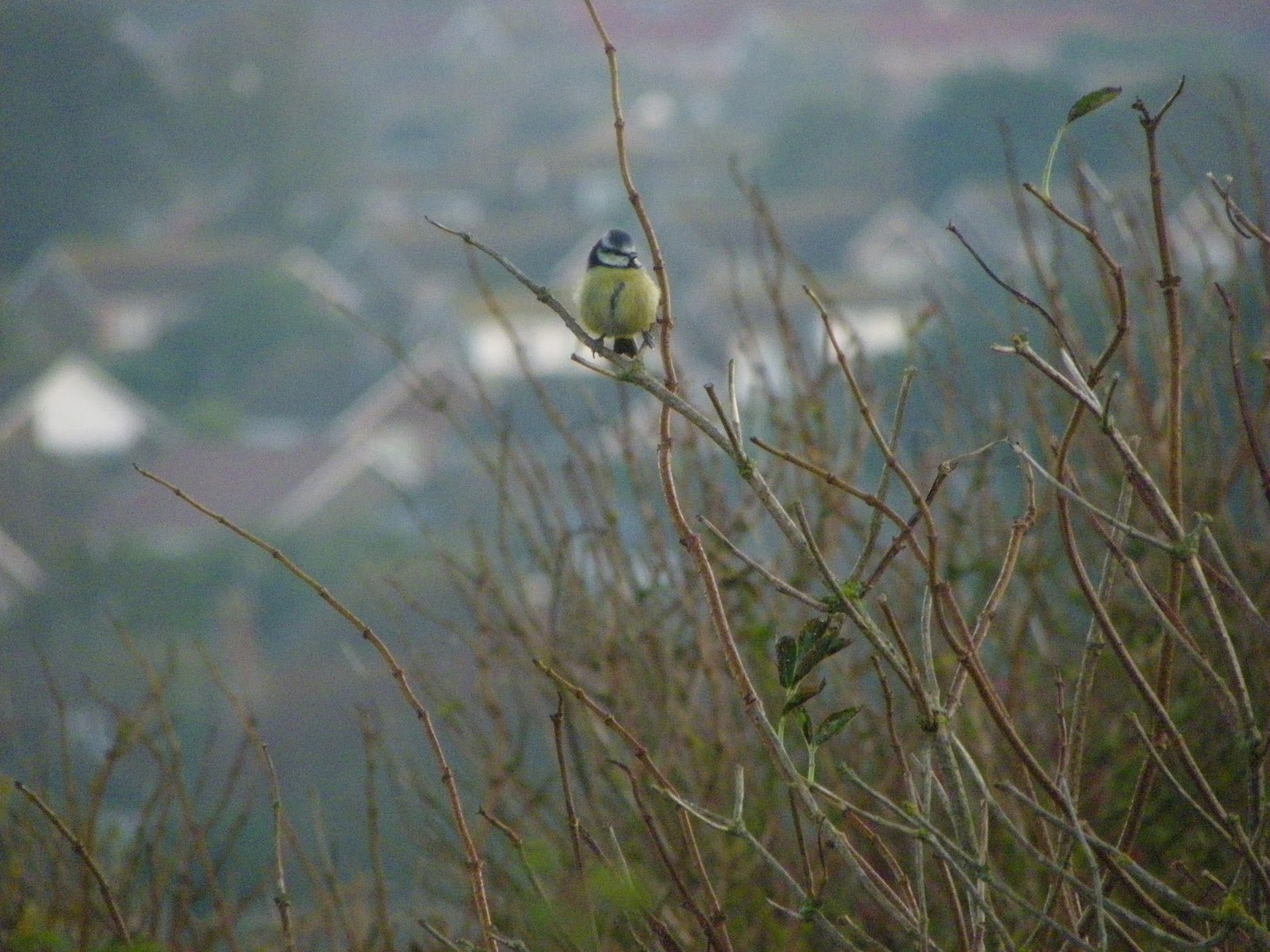
Blue Tit, on Seaford Head Golf Course

a group of Jackdaw on the fence running parallel to the Golf Course


 hundreds of Goldfinch were in this flock at Hope Gap!!!